Unknown's avatar

About Cheryl Biswas

Writer, reader, techie, Trekkie. InfoSec and political analyst. Keeping our world safe one byte at a time.

It’s Baaack – The Return of CryptoLocker

Since last week I’ve been following some fascinating reports about the return of this ransomware behemoth. There are increasing accounts about the resurgence of CryptoLocker ransomware.  As we have learned with Lazarus Group and Shamoon, just because it’s dormant doesn’t mean it’s dead.

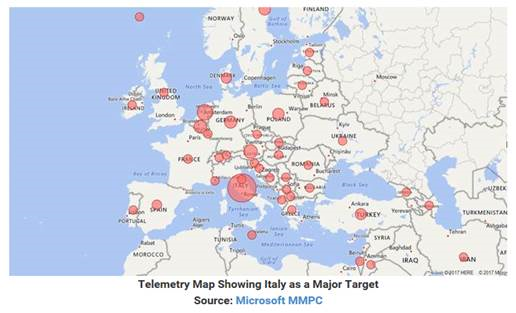
Attacks have been steadily climbing since January. And what is interesting is how attackers are leveraging the Certified Electronic Email in Italy to spread the joy. This service is used by people who want the assurance they are getting a high level of security. The attack vehicle was a carefully crafted email featuring a digital signature to appear very trustworthy. Attackers utilized Italy’s Certified Electronic Email which legally is like a registered letter, to deliver invoices hiding spam. And it worked. This parallels the similar rise in Dridex in Switzerland reported mid February, again leveraging trusted email providers. As we know, phishing works. “Trust” works. Put the two together … …Attacks were predominantly in Europe, the staging ground for Russian cybercriminals before they launch their malware on America.  Attacks are now heavy in the Netherlands, and have landed on American shores as confirmed by Microsoft’s Malware Protection Center.

Sources: https://www.scmagazine.com/cryptolocker-bursts-onto-scene-again-targeting-europe-and-us/article/641731/

https://www.bleepingcomputer.com/news/security/crypt0l0cker-ransomware-is-back-with-campaigns-targeting-europe/

Shamoon Update: Ransomware and New Wiper Malware Discovered

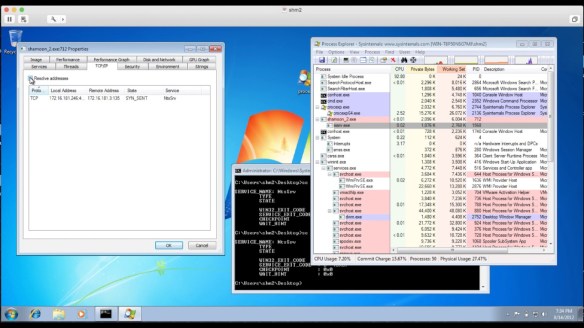
Wiper malware is rare – just a handful of occurrences have been documented. However, in the latest appearance of Shamoon, a new ransomware component was uncovered in addition to the disk wiping capability. Because you can’t have too much of a bad thing it would seem.  The ransomware component hasn’t been deployed but is ready for use. The Shamoon 2.0 dropper is a worm that infects computers in Windows domains, leveraging hardcoded previously stolen usernames and passwords. Kaspersky has released a full report on it.

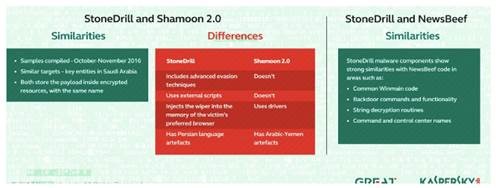
Kaspersky has now identified another wiper malware in the wild. Dubbed “StoneDrill”, it has targeted organizations in Saudi Arabia, but it also went after a petrochemical organization in Europe. At this stage, it seems StoneDrill is similar to the APT group NewsBeef or Charming Kitten, who was linked to the latest Shamoon endeavours. Kaspersky notes “Particularly interesting is the heavy use of anti-emulation techniques in the malware, which prevents the automated analysis by emulators or sandboxes.” far more so than Shamoon.  It also uses VBS scripts to run self-delete scripts but Shamoon did not rely on any external scripts. Also, the disk wiper module in StoneDrill does not get written to disk like Shamoon does. Instead, it is injected directly into the user’s browser process memory, no drivers required.


Source: https://threatpost.com/destructive-stonedrill-wiper-malware-on-the-loose/124090/

https://securelist.com/blog/research/77725/from-shamoon-to-stonedrill/

The ABC’s of APTs: Shamoon

sham35Welcome to the grey zone where politics and cyber meet. APTs or advanced persistent threats, are one of my favourite acronyms (but then you know how I am intrigued by Stuxnet and cartels), and essentially are how nation states get their digital digs at each other. Usually the intention is to get information, because knowledge is power. Cyberespionage can give a competing nation a real competitive advantage in the world economy, among other things. But sometimes, there is a need to control more, and that is where weaponizing code takes on a whole new nasty.

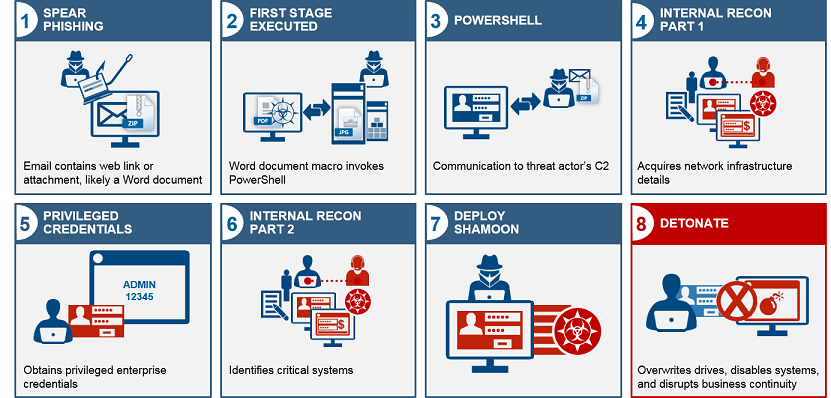
The keyword here is “persistence.”  First, attackers must find their way into the networks of the target. Usually, they employ targeted spear phishing, painstakingly staking out the right victim to receive that loaded email.  The investment of time and money at this point is essential, so as not to tip anyone off. And the emails are crafted so carefully, picking up on points tailored to that recipient so that they will open it, and launch the attachment that will create an entry point for the attacker. There is a reason why phishing is at the heart of so many breaches.

Now, imagine a video game, where you must progressively meet the challenges of each level to go higher. That is the attacker moving through the network, acquiring credentials to gain access to the crown jewels. The strategy is to find someone lower level, then work your way up. Hence, persistence, because this is an investment of both time and patience. Expect the key executives or decision makers to be well-guarded, with access and authorization controls in place. Not the case for someone lower on the food chain. All an attacker needs is to gain access. As proven repeatedly, once in, they can take all the time they need to find what they want. Case in point: the attack on the Ukraine power grid in December 2016.  The attackers were in that system for over nine months, collecting what they needed, notably credentials for the Virtual Private Network, that enabled them to jump the security gap onto the restricted side. As Stuxnet taught us, there is no such thing as air-gapped security.
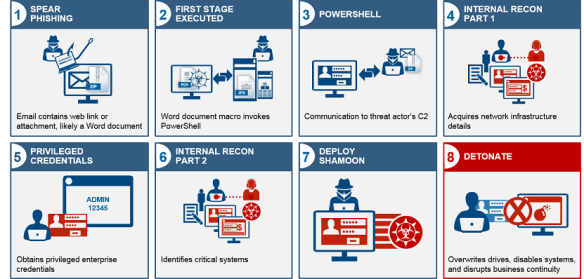
shamoonattackgraphic

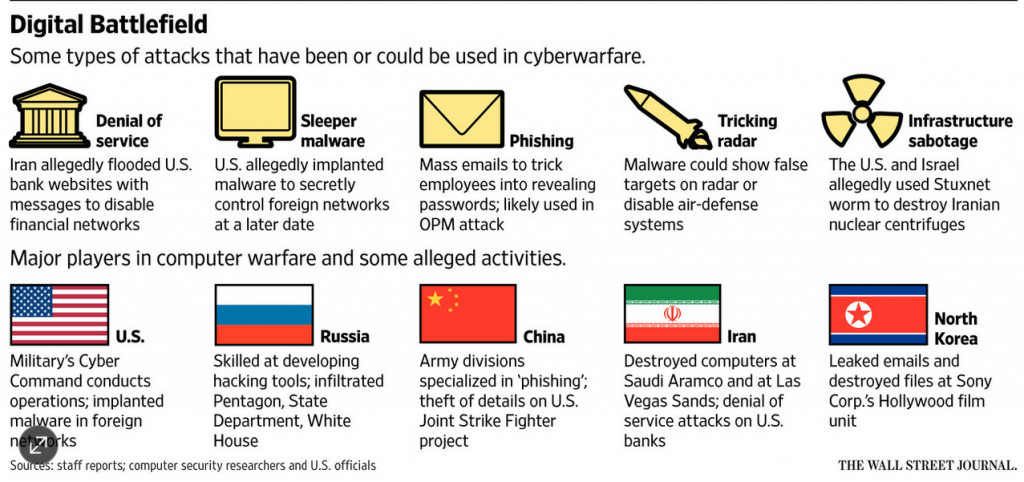
We know the Russians hacked the US; we know China hacked the US and Canada; and yes, the US has hacked someone too. These are the games nations play. The trick, of course, is not to get caught before you have the prize. And when you do get caught?  Well, as we’ve seen play out, nothing really bad happens. Just expect that your victim will be in your systems. Unless information isn’t the endgame and control is. Then, be prepared for something to go bump in the night.

Shamoon is devastating wiper malware that took out a massive swath of Saudi Aramco when it first debuted in 2012.  Linked to Iran, and an ongoing feud in the region between key players, it was a targeted attack against the oil giant, damaging or destroying 35,000 computers. Sec Def at the time, Leon Panetta, described it as “probably the most destructive cyber attack on a business.”

Wiper malware was used against business targets in  December 2014 destroying the systems in a Vegas casino, The Sands, after owner Sheldon Adelson advocated using nuclear weapons against Iran. The US “publicly cited Iran as the culprit”.   Then Disstrack was used again in December 2015, in the attack that brought Sony to its knees.  These aren’t gangs using cybercrime for monetary gain. These are the equivalent of acts of war, given the level of damage done.

Fast forward to late 2016. Two major attacks happened in Saudi: November 17 taking out systems at the airport and other Saudi government agencies, and then again on November 29. Then, on January 23 there was another attack. The malware used was almost identical to the original Shamoon, aka Disstrack.  Except there were a few key enhancements.  According to Andrew Plato, CEO of Anitian Enterprise Security

 “What is really worrisome about this is it’s just outright destructive. It isn’t really trying to steal anything. It’s the closest things we’re going to get to a cyber bomb”.

The new version, dubbed Shamoon 2, spread through the local network using legitimate counts belonging to users and administrators, with complex passwords likely obtained from an earlier attack. Remember what I said about persistence?  This new version, however went on to attack VDIs, or Virtual Desktops, which previously could have offered some protection because of their ability to load snapshots of systems that were wiped. Now Shamoon had migrated from just Windows-based systems to Linux in the attacks on VDIs.
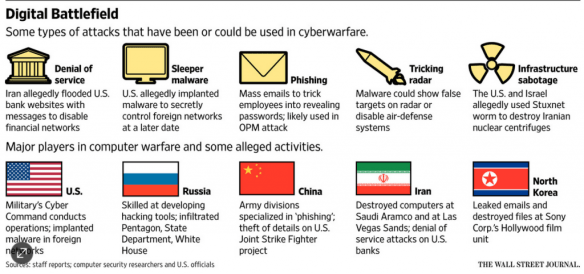
cyberwar1-1024x482

Now, I don’t want to be alarmist and spread FUD everywhere. Yes, this is serious and destructive. Like Stuxnet, it broke things. And that’s the differentiator. So far, the line hasn’t been crossed where breaking things was deliberately done to harm people. Because as Archer would say: You want cyberwar? Because that’s how you get cyberwar.

While the expectation is that Iran is once again behind the attacks, Symantec has revealed there are multiple parties involved. More than one entity, so collaboration and cooperation.  The report is that an entity known as Greenbug may have assisted in getting the credentials needed for access.  Palo Alto reported on a campaign known as Magic Hound which targeted energy, technology and government with ties or locations in Saudi.  There were links between Magic Hound and two other actors with Iranian ties: Charming Kitten and Rocket Kitten. Finally, putting all this together was the group Timberworm or Cobalt Gypsy.  Per Symantec, Timberworm was behind the January 23 attacks.

Here’s the play by play. First, Timberworm used spear phishing emails with weaponized documents (we warned you about those Office Macros!) to gain initial access into the network. Once there, they used custom malware, along with leveraging existing sysadmin tools to avoid detection, and help them achieve persistent remote access. Quick FYI: custom malware is a hallmark of major organized cybercrime groups or nation state attacks because it costs a lot of time and money to craft, and the stakes are going to be very high.

Apparently Greenbug and Timberworm have been active, penetrating organizations beyond Saudi. Note that Shamoon, however, was only used against the Saudi target. Timberworm is a large operation, as is Greenbug, with targets in a range of areas. We know who they are now, what they can do, and that they have a shared interest. What we don’t know: the endgame. I’m waiting for that other shoe to drop.

http://www.zerohedge.com/news/2016-12-01/another-false-flag-destructive-iranian-hackers-allegedly-wreak-havoc-saudi-computer-

http://www.securityweek.com/shamoon-2-variant-targets-virtualization-products

http://www.securityweek.com/multiple-groups-cooperated-shamoon-attacks-Symantec

http://www.archersecuritygroup.com/second-wave-bomb-malware-hits-saudi-arabia/

Necurs Botnet + DDoS

https://www.linkedin.com/hp/update/6240979895925768192

Just adding this here as a heads up to keep watch over. Necurs has built itself out as a lucrative vehicle to deliver Locky ransomware and Dridex banking malware, along with an effective Spam campaign. 

What is interesting is that DDoS destroys the bots in the army, which would not serve the interests of those running Necurs. We know that cybercrime really is an ideal model of business efficiency. 

Nonetheless, we need to keep watch over Necurs, and be aware of all its capabilities. Cuz pivots happen. Fast. And this year my prediction is we are going to see banking malware do what ransomware did last year.

Ransomware Updates

We’ve got some new stuff out there. First, for those who torrent, be careful. If you torrent on a Mac, be very careful.  For the second time, ransomware has been designed for the Mac OS.In this case, “Patcher” is poor quality, shoddy code, to the extent that if the victim pays the ransom, they don’t get their files back because that code doesn’t work. It’s getting dropped via fake Adobe Premier Pro and Microsoft Office for Mac.

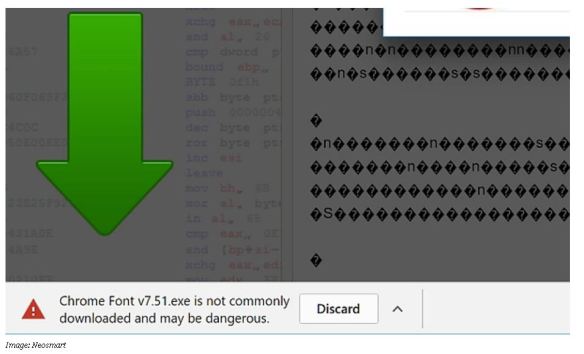
Second, if Google is telling you “Hoefler test not found”, don’t think you need to install that font. It’s a ploy on certain compromised websites to drop Spora ransomware. And very few AV or anti-malware programs can detect this one.

spora.JPG But, if you play it safe and do as Google says, click Discard and don’t download.  You’ll avoid ransomware.
If you want to know more, I’ve got a Ransomware page.

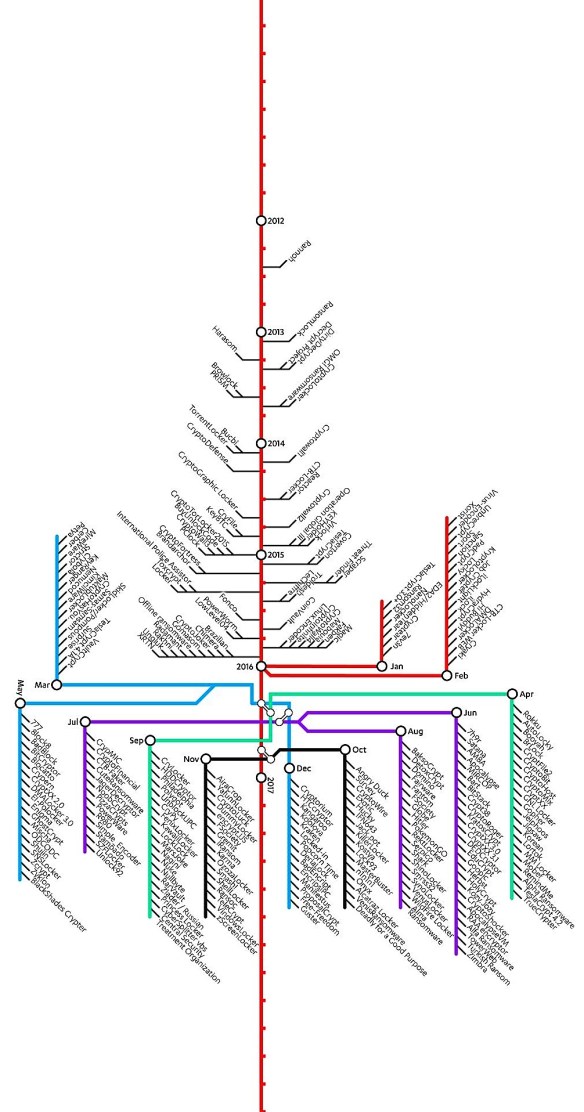
And saved the best for last. This amazing map from F-Secure shows the timeline of ransomware.  You can see the explosion that took place in 2016.

ransomware-tube-map

https://www.f-secure.com/documents/996508/1030743/cyber-security-report-2017


Banking on Insecurity

They came for the money, they stayed for the data. There is far more at stake in financial services than dollars and sense. The past twelve months have shown how far attackers are willing and able to go; banks are known for their conservative pace in adopting new strategies, and attackers are literally banking on it.

As the saying goes, “In God we trust”. In banks, maybe not so much.  According to a recent report by Capgemini, one in five bank execs are “highly confident” in their ability to detect a breach, never mind defend themselves against it.  Yet “83% of consumers believe their banks are secure from cyber attack”.  One in four banks report they’ve been attacked, but only 3% of consumers believe their bank has suffered a breach. Never mind the money. How about the data? Survey shows that 71% of banks don’t have a solid security strategy in place, nor do they have adequate data privacy practices. The numbers are not good. Only 40% of banking and insurance companies have automated security intelligence capabilities for proactive threat detection

After following the trail on the SWIFT bank heists last year, I’ve paid close attention to banking malware, threat actors, and points of failure. What worries me is what’s coming as digital payments become the norm, and digital identities take hold in developing nations who lack the infrastructure or regulation to secure or enforce. Given what we already know, what does this recent history of attacks tell us?

Polish Banks
The recent series of targeted malware attacks against Polish banks was identified in January this year, but attackers went after the data, not money. After noticing unusual network activity, like traffic to “exotic” locations and encrypted executables that nobody knew of, and unauthorised files on key machines in the network, several commercial banks confirmed malware infections. Investigations revealed infection stemmed from a tampered JS file from the webserver of the Polish financial sector regulatory body.  This was actually part of a wider campaign that has gone after financial institutions in over 30 countries.  According to researchers from both BAE Systems and Symantec, the malware used in Poland can be linked to similar attacks around the globe, and there are marked similarities to tools used by the cybercrime group Lazarus, although no confirmation has been made.  Targets were led to compromised sites of interest to them, watering holes, which were malicious sites that injected code and directed the targets to a customized exploit kit.  This kit contained exploits against known vulnerabilities in Flash Player and Silverlight. What’s interesting is that the exploits were only activated for certain visitors: those with IP addresses from specific ranges. Per Symantec, “The IP addresses belong to 104 different organizations located in 31 different countries … The vast majority of these organizations are banks, with a small number of telecoms and internet firms on the list.” 15 of these are from the US.  The infection downloaded enables recon on the compromised system. Again, this tool is similar to those used in past by the Lazarus group. Now every major security group has published their opinions and analysis on what was originally all but overlooked as some malware that spread from the regulatory body’s server.

Fileless Malware Attacks
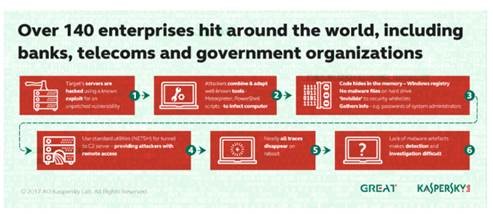
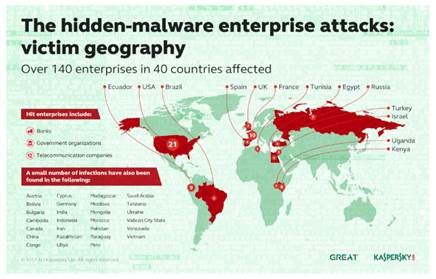
In January of this year, there were reports around the globe of attacks on banks using fileless malware. The malware resided solely in the memory of compromised systems.  This is not signature based malware that can be referenced and detected. According to Kaspersky, 140 enterprises in 40 countries have been hit. And forensics cannot help us:

“ memory forensics is becoming critical to the analysis of malware and its functions. In these particular incidents, the attackers used every conceivable anti-forensic technique; demonstrating how no malware files are needed for the successful exfiltration of data from a network, and how the use of legitimate and open source utilities makes attribution almost impossible.” 

But the infections are hard to identify so that number could well be more.  Further complicating things is the use of legitimate and widely used sysadmin and security tools  like PowerShell, Metasploit and Mimikatz for malware injection. In a range of incidents, the common denominator seems to be embedding PowerShell in the registry to download Meterpreter. From there, the attack is carried out using the native Windows utilities and sysadmin tools. Per Kaspersky:

fileless1fileless2

The new fileless malware hitting banks is Duqu 2.0, which Kaspersky found on it corporate network in 2014, but only after it went undetected for 6 months because it lives almost completely in the memory of the computers. Duqu 2.0 is derived from Stuxnet. The malware renames itself when an infected computer is rebooted so digital forensics has a tough time finding traces. The calling card seems to be the unusual embedding of PowerShell into the registry to download Meterpreter. Duqu 2.0 is derived from Stuxnet. Reports aren’t saying how the malware spreads.

TESCO Bank Attack
In November 2016, Tesco Bank, a British retail bank chain with 7 million customers, warned its customers to watch for suspicious money withdrawals. Unfortunately, when customers who noticed money was missing from their accounts reached out to the bank, many could not get through. Approximately 20,000 accounts were hit. Tesco briefly halted online transactions in response. The attack seemed to stem from a “systemic failure of security around Tesco’s core database”. Recommendations include having controls in place to alert on changes to key files and configurations. As well, file monitoring integrity and Configuration Management Security ensure that if and when changes are made, they are valid and validated.

Take the Money and Run:  COBALT, ATMs and ‘Jackpotting’
There was a distinct rise in ATM attacks over 2016.  The latest siege, Cobalt, covers a wide swath across the UK, Spain, Russia, Romania, the Netherlands, much of Eastern Europe and Malaysia.  According to Group IB researchers, a large number of machines are attacked at once, and Cobalt appears to be linked to cybercrime syndicate Buhtrap.  The malware used causes infected machines to spit out cash in an attacks known as “jackpotting”.  Noteworthy is how this is being described as “the new model of organized crime”.  The FBI issued warnings to US banks following those ATM heists, taking into account the attacks in Taiwan and Thailand, when thieves grabbed over 260,000 pounds from Thailand’s Government savings bank and $2.5 million from Taiwan. The world’s two largest ATM manufacturers, NCR and Diebold Nixdorf, worked to manage the threat.

Lloyd’s Bank Hit by DDoS Attack
In January the venerable Lloyd’s Bank of London was struck by a DDoS attack that lasted two days.  Attackers tried to crash the Lloyd’s site, causing issues for customers and impacting some access to online banking.  The bank did not lose money, nor data, nor was the impact significant.  Law enforcement is investigating.

Attacks on Banks in the SWIFT System
Banks rely on messenger systems to conduct transfers back and forth. In 2016, a series of targeted attacks on banks in the trusted SWIFT messenger system came to light after a massive heist on the Bank of Bangladesh. Apparently the attacks are evolving, and SWIFT has told member bank, in an undisclosed letter from Nov. 2, that “attacks on its systems have only become more sophisticated in their strategies”.  “The threat is very persistent, adaptive and sophisticated – and it is here to stay”.  This is despite the work by regulators globally to toughen bank security measures. And the word is that “a fifth of them are hitting paydirt for the attackers”, per Stephen Gilderdale, head of SWIFT’s Customer Security Programme. Now the hackers exploit tech support software to gain access. Then send victims phony payment instructions via SWIFT network.  SWIFT emphasizes that all those attacks detected “exploited SWIFT interfaces used by its customers” but that the SWIFT communications network itself was not impacted. In light of this, warnings are being issued to small businesses to realize the threat to them is real.  Scams have become more sophisticated and will continue to evolve. 

Sources:

https://badcyber.com/several-polish-banks-hacked-information-stolen-by-unknown-attackers/
https://securelist.com/blog/research/77403/fileless-attacks-against-enterprise-networks/
https://www.symantec.com/connect/blogs/attackers-target-dozens-global-banks-new-malware-0
https://baesystemsai.blogspot.sk/2017/02/lazarus-watering-hole-attacks.html   https://threatpost.com/fileless-memory-based-malware-plagues-140-banks-enterprises/123652/
http://www.welivesecurity.com/2017/02/16/demystifying-targeted-malware-used-polish-banks/?utm_source=organic%20twitter&utm_medium=news&utm_campaign=WLS   http://economictimes.indiatimes.com/industry/banking/finance/banking/indian-banks-are-waking-up-to-a-new-kind-of-cyber-attack/articleshow/56575808.cms
https://www.f-secure.com/documents/996508/1030743/cyber-security-report-2017

How to Give a Talk in InfoSec

We all needed this page at one point. Or more. I know I did and thank you to the people in our community who had stuff like this for me to find. My turn to pay it forward 😊

“Do that thing which scares you”

I know. It seems so difficult. Feels so scary. But the best advice I can give you as you start out is this:  give a talk. And CFP or Call for Presentations season is now in full swing, meaning deadlines and duedates need to be tracked. Deadlines can be 5 months before the Conference takes place. Don’t let this opportunity pass you by.

You may be able to start small, with a local meetup group. Someplace you feel comfortable, where you can talk for 20 minutes or more, on something you are excited to share and would love to explain.

Why talk? Why not just write or post? Well, a talk is more than just words on a screen. We get to see and hear your passion, which elevates your concept to another level. And we get to see – you! In a community of introverts, facetime is powerful. We love to learn by watching videos of talks given. Like yours. The other plus is that you get to attend a Con, which if you have read any of my posts, is both incentive and reward.

Where to even begin? Here. So relax and just start by reading to see what it is all about. There are people to reach out to in our community if you want to do this, like me. I am happy to be of help. @3ncr1pt3d on twitter :).

Watch the vidoes of past presenters from where you want to speak. Or those who talk about what you want to talk about. Know what has already been covered so you can bring something new. Or get a sense of what is trending. Plus, you can see how people deliver a talk. How slidedecks are put together. What humour works. An incredible resource is this site: http://www.irongeek.com . Adrian Crenshaw records talks at so many conferences. You’ll find whatever you need here.

Here are some terrific online resources to guide you:

https://thesweetkat.com/blog/.  Kat Sweet has both given talks and evaluated them. Trust her. She is friendly, so smart, and very good at talks. Great starting place.
https://danielmiessler.com/blog/build-successful-infosec-career/#cfp. What you need to know about putting together a good talk. It starts with an idea that develops far beyond words on a page. You want to make sure you knkw about format, deadlines, requirements etc.
https://defcon.org/html/links/dc-speakerscorner.html#nikita-cfp. Now you are ready to hear the hard truth. Let’s make that paper stand out in a sea of submissions. You can be among the chosen, but only if you make your talk worthy.

https://www.helpnetsecurity.com/2016/03/30/how-to-get-your-talk-accepted-at-black-hat/  And then there is Black Hat.  Why not aim high? Here are some suggestions to help you get noticed from one of the top-tier conferences, and Stefano Zanero, attendee and reviewer.

Is this your first time? Don’t be shy. We all had a first talk. And BSidesLV offers Proving Ground, a fantastic program at the start of their CFP phase to invite new speakers and pair them with a mentor. I know. That is how I started and it was amazing. Even better are the relationships you build here which carry forward, along with the learning. Because InfoSec is a community and our strength is in our people. Take a look here: https://bsideslv.org

Okay. Pep talk. You are good enough, smart enough and one of us. We want to hear what you have to say and we are willing to help you do it. Go for it!

You can find this under Learning

Recent Polish Bank Attacks. Where There’s Smoke …

Last week I tracked a story about attacks on Polish banks. What was interesting was that attackers came for the data, not the money. As well, the attack itself was described as sophisticated. Those reporting the story were concerned, and remarked that this was one of the most serious cyber attacks on banks Poland had suffered.

We know that cybercrime is actually one of the most efficient business models there is. The attackers have refined their tactics and techniques to maximize gain and minimize effort. Sophisticated involves time, money and effort – the purvue of nationstates usually, and the realm of APTs or Advanced Persistent Threats, like Stuxnet.

In this case, several polish banks  reported they noticed  unusual network activity, like traffic to “exotic” locations and encrypted executables that nobody knew of,  and unauthorised files on key machines in the network. Further investigation confirmed malware infections.The attack was not a quick hit and run but sophisticated, gaining control over critical servers in the bank’s infrastructure:

“the malware used in this attack has not been documented before. It uses some commercial packers and multiple obfuscation methods, has multiple stages, relies on encryption and at the moment of initial analysis was not recognised by available AV solutions.  The final payload has the functionality of a regular RAT”

As of last Thursday, when I shared what I found, there was a suspicion  infection stemmed from a tampered JS file from the webserver of the Polish financial sector regulatory body. today, it was confirmed.  The site of the regulator for Polish banks was indeed contaminated with malware by some foreign source. The malware was responsible for data exfiltration, reconnaissance, and other undesirable activities.  This is why we need to be paying close attention to what comes next:

This particular malware appears to be a new strain of nasty software which has never seen before in live attacks and has a zero detection rate on VirusTotal.

There is no confirmation as to who is responsible, or what data was taken. One year ago, Polish banks were hit by Goznym, in a series of targeted attacks. While this isn’t Goznym, we should be looking for patterns and ties. This serves are a major heads up. What are we seeing? Where aren’t we looking?

https://badcyber.com/several-polish-banks-hacked-information-stolen-by-unknown-attackers/

http://thehackernews.com/2017/02/bank-hacking-malware.html


My Approach to Threat Intel

In my role at work as a Threat Intel analyst, I track developments using various media feeds, and put together a succinct daily report of several key items that are pertinent to our clients and business lines.  Of course, I share my findings on Twitter and LinkedIn because that’s how the security community flourishes: collaboration. And to say I love what I do would be an understatement.

I don’t pretend to be an expert at what I do, nor will I say I have the definitive definition of what Threat Intel is. There is so much information to capture and analyze, and the learning is continuous. For me, my love of threat intel is in the hunt: looking for trends, patterns, new developments, things that reappear.  If you seek, you will find. There are many ways to search, and I am always trying to learn from people who have been doing this longer. It’s like fine-tuning a guitar, so I’ll always be looking at how to improve what I do.

I have go-to sources I read regularly, people online I follow specifically. My twitter feed is huge and categorized. But if I want to know something right away, it’s usually on there. I also have other sources to check in with directly. I collate information on malware, Advanced Persistent Threats (my most favourite things), specialized systems and their unique vulnerabilities.  This has helped me develop a baseline understanding over the time I’ve been doing this, so that I can understand who the players are when it comes to exploit kits, ransomware or DDoS.  And I try to make sure I know who the experts are, so that when they find something I am paying attention. That’s the head’s up.

When I’ve talked on Blue Teaming with my awesome pal, Haydn Johnson, we refer to the importance of knowing your baseline, watching patterns, so that you can identify anomalies. Those are your threats. That is your head’s up.  I find the same thing here as I track tweets, stories, advisories, reports and blogs.  I look for evolutions in how malware is delivered, so changes in exploit kits, or for kits to disappear from site. That means those kits are going to reappear with a new twist that our standard levels of detection and protection may not recognize, so attackers can access systems. Or, it could mean a larger scale attack, like Carbanak, when a massive crime gang operates on a global level and banks get taken for $1 billion. I play a lot of “what if” because I find I need to think beyond the normal realm to expect the unexpected. After all, the attackers are going where we aren’t looking.

In the weeks to come, I will be trying to bring in more information to widen my search. I’m researching all I can on what experts think best defines Threat Intel and Hunting. Because to really capture what’s out there, we need to broaden our scope.  I want to be looking ahead of the curve in this chase, anticipating their next move based on the wealth of information we have at hand, and factoring in what we know about human behavior. Next gen tech has spawned next gen threats, and as always, the attackers are ahead of us. And here is the thrill of the hunt.